On-Premises Personal Agents
Run your own personal-agent platform on your own servers, giving each employee or customer a personalized agent that remembers them and acts for them within the permissions you set.
LIVE
Hosted services running on FinAI OS today. Try them in your browser, sign up, and go live without deploying anything.
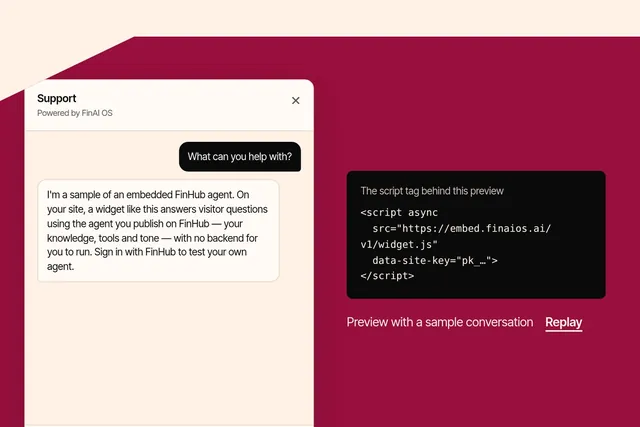
Put an agent you publish on FinHub onto any website with one script tag, in your brand and your visitors' language. Try the playground or sign up at embed.finaios.ai.
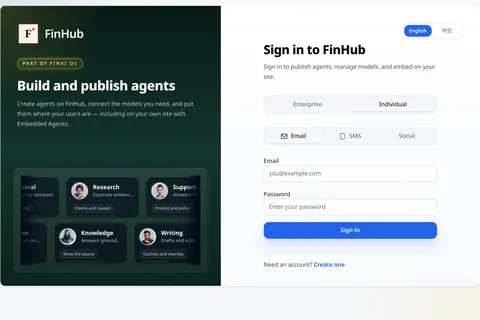
FinHub is the governance and work plane for your company's agents, including the Super Agent work layer. Policy, identity, audit and skills stay on the platform, so you are not locked to one harness.
Solutions
AI Governance & Evidence
Our Forward Deployed Engineers (FDEs) build and run an evidence store on your own infrastructure. The engagement brings scoped event intake, agent and model inventories, and case-review work alongside FinSafe, FinShield and FinGuard records and policy enforcement. Named reviewers reconstruct what happened, separate observations from assumptions and keep evidence gaps visible.
Ways to start
choose its owner, records and business-system routes. Our FDEs build the store and intake for that scope, and configure an agent and model inventory with your team. People confirm ownership and update responsibilities.
begin with the question to answer, not a request to collect everything. Assign an analyst and agree who may access sensitive content. Use existing records before deciding whether additional collection is necessary.
Review
Distinguish the attempted action, control decision and downstream result. A policy entry alone does not prove a business-system change; an application result alone does not explain the boundary. Review the connections, and state where the available records cannot establish them.
Solutions
a team reports that an assistant attempted the same business update twice. The case owner records the reported time, the intended change and the affected workflow. The initial report is a question to investigate, not a finding.
the reviewer checks available execution records, the relevant FinGuard journal entries and the business system's result. Where request identifiers and timing support a connection, the reviewer records the basis. Where they do not, the gap remains explicit. A duplicate response in the gateway record is assessed alongside the downstream result; no missing event is invented to complete the story.
Solutions
use FinSafe isolation or desktop FinShield to constrain the execution environment. Check the applicable permissions and available records; do not infer that isolation makes the generated content correct.
FinGuard applies configured rules to actions routed through it. Its idempotency ledger handles repeat writes, credential custody keeps enterprise secrets outside agents, and its journal and hash-chained audit record the action decisions.
our FDEs build and run the store and case-handling setup; people assess the available material and write findings. Keep source references with each conclusion and name the follow-up owner. Our FDEs configure human approval for selected FinGuard action paths and tamper-evident evidence bundles for case review. Reviewers still assess coverage and missing records.
Privacy
Request only what the case needs. Limit access to full content, separate working notes from original records and agree handling and retention with the owners. Where possible, share an aggregate summary rather than raw personal material. The organisation decides what to report and to whom; a vendor or assistant does not take that responsibility.
Products
our engineers build and operate the store on your infrastructure, configure telemetry and OTLP intake for agreed sources, and maintain the agent/model inventory setup with your team. This service layer is distinct from the products and their own records.
FDE
FAQ
No. It constrains execution and access, not the truth of an answer.
Yes. Host privileges are a boundary of the protection and must be considered in the review.
No. Coverage depends on routing actions through it, controlling accepted credentials and constraining network paths. Examine bypass routes.
No. Model processing is separate. Check the endpoint and where prompts and tool output go.
Our FDEs build and operate it on your infrastructure as an engagement, not a self-serve software package. Your team owns the findings and reporting decisions. Available records and configured intake define the scope; a store does not make missing evidence complete.
Next step
We build and run its evidence-store setup on your infrastructure, while your team keeps responsibility for review, gaps and conclusions.