On-Premises Personal Agents
Run your own personal-agent platform on your own servers, giving each employee or customer a personalized agent that remembers them and acts for them within the permissions you set.
LIVE
Hosted services running on FinAI OS today. Try them in your browser, sign up, and go live without deploying anything.
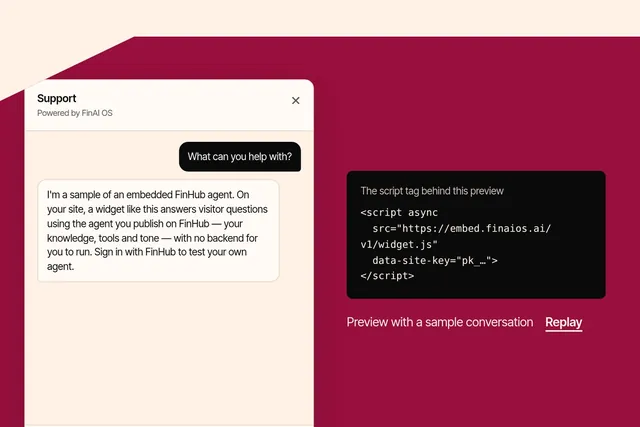
Put an agent you publish on FinHub onto any website with one script tag, in your brand and your visitors' language. Try the playground or sign up at embed.finaios.ai.
FinHub is the governance and work plane for your company's agents, including the Super Agent work layer. Policy, identity, audit and skills stay on the platform, so you are not locked to one harness.
Solutions
An agent needs to know what your business means, where an answer comes from and which actions are allowed. Bring those responsibilities together without confusing them: agree the definitions with your experts, query source knowledge with citations, and enforce action rules outside the prompt. Our FDEs build and run the knowledge setup, configure FinLore release pinning, and provide compilation from reviewed Fintology rules to FinGuard configuration. Gateway enforcement remains a separate responsibility.
Ways to start
choose a document set and a recurring staff question. Identify its owner, who may use it and what makes an answer acceptable. Begin with read-only work so people can evaluate sources without changing business records.
select a business operation and write down its conditions. Keep the rule configuration separate from the assistant's instructions. A well-written prompt is useful guidance, not an enforcement boundary.
Solutions
A “client” in one system may not mean the same thing as a “client” in another. A correct quotation can still come from an outdated procedure. An assistant may understand a policy but lack permission to carry out the next step.
Treat these as three different checks. Business owners settle terminology; document owners review source relevance; system owners configure action rules. This makes disagreements visible instead of allowing the assistant to resolve them by guessing.
Solutions
a colleague asks which documents are needed to change a business account. The answer cites a source procedure. The colleague checks the referenced passage before requesting a change. A citation is a route back to the evidence, not a guarantee that the procedure is current or fits this case.
the process owner compares the request with the agreed meaning of “account” and the current procedure. A system owner separately maintains the rule checks in FinGuard for routed writes. For actions requiring human judgement, our FDEs configure FinGuard approval handling and the responsible reviewers. A named person makes the decision; an assistant cannot treat its request as permission.
Operations
Keep a reviewed glossary and identify who resolves conflicting definitions. Ask reviewers to record the disputed term, the source and the business impact. Failed questions become a human-owned backlog: someone examines the source, decides whether a correction is needed and checks the result.
Products
the shared business-model and definition vocabulary. Our FDEs work with experts on meanings and reviewed rules, and provide the compilation path into FinGuard configuration.
source knowledge with citations. Our FDEs deploy and operate the knowledge setup and configure release pinning so the team identifies the knowledge release in use.
a stateful, rule-based action gateway. Configure its rules independently; it checks routed actions, uses idempotency to handle repeat writes, keeps a journal and holds enterprise credentials outside the agent.
Illustrative
FDE
FAQ
No. It makes the source inspectable. People still need to check relevance, context and currency.
System owners configure enforcement separately from the business definitions, with FDE help. Our FDEs provide compilation of reviewed Fintology rules into gateway configuration; people review that configuration before it governs actions.
Name a process owner and use your team's review procedure. Do not treat an exception request as permission to act.
No engine is prescribed. Review the chosen runtime, knowledge access and action route for the actual deployment.
Yes. A read-only question-answering task lets your team check vocabulary and sources before connecting an operation that changes records.
Next step
Make the meaning explicit, inspect the evidence and give each action a separate boundary.