On-Premises Personal Agents
Run your own personal-agent platform on your own servers, giving each employee or customer a personalized agent that remembers them and acts for them within the permissions you set.
LIVE
Hosted services running on FinAI OS today. Try them in your browser, sign up, and go live without deploying anything.
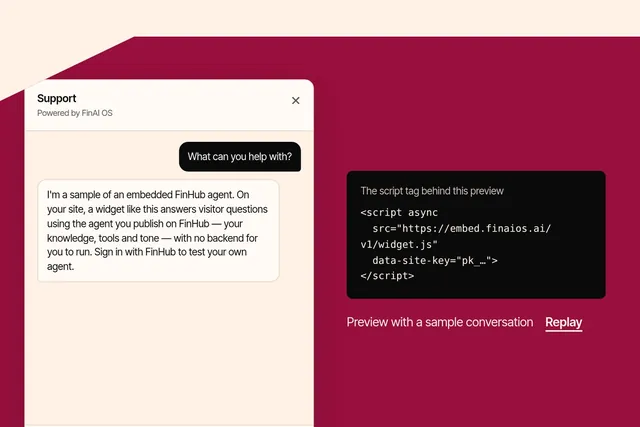
Put an agent you publish on FinHub onto any website with one script tag, in your brand and your visitors' language. Try the playground or sign up at embed.finaios.ai.
FinHub is the governance and work plane for your company's agents, including the Super Agent work layer. Policy, identity, audit and skills stay on the platform, so you are not locked to one harness.
Guides
Learn how an AI action gateway checks business-system changes, handles repeat requests and holds risky actions for approval, alongside your existing gateways.
An AI action gateway checks what an agent is about to change in a business system. It sits on the action path, between the agent and systems such as a customer database, an order service or a support platform.
That is a different question from whether a model request is allowed or a tool is reachable. A valid request can still repeat a change that already happened, exceed the agent’s authority or need a person’s approval.
Consider an illustrative case: an agent asks a support system to create a ticket. The connection times out before the agent receives the result. The ticket may already exist. Retrying without checking can create a duplicate.
An action gateway with an idempotency ledger records the request and its outcome. A repeated request with the same key can return the stored result instead of making another change. If the earlier attempt timed out, its outcome must be checked before retrying. The request key and target-system integration matter; this is not a promise to recognise every similar request automatically.
A model gateway handles access to model providers and model traffic. An MCP or agent gateway handles access to tools or agent services. Those gateways can remain in place.
An action gateway adds controls at the point where a request changes business data. The decision is specific: should this change happen now, has it happened already, and does it require approval? Gateway capabilities vary; these are complementary responsibilities, not a claim that all other gateways lack state or approvals.
FinGuard is a stateful, rule-based AI action gateway. It keeps an action ledger, checks policies, holds high-risk actions for human approval and records allow-or-deny decisions in a tamper-evident journal. Agents cannot approve their own pending actions.
FinGuard holds the protected system’s credentials rather than giving them to the agent. To make it a required route, configure credential custody and network restrictions so an agent cannot bypass it. Installing a gateway alone does not protect unrelated paths.
Choose one system, identify the changes agents may request, and agree the repeat-request and approval rules with its owner. Test allowed, denied, repeated and timed-out requests, along with approval and recovery paths, before expanding access.
A gateway does not decide whether every business judgment is correct. Your business rules, model evaluations and accountable reviewers remain necessary.
Explore FinGuard’s action controls, or talk to a Forward Deployed Engineer about the first system you want to protect.