On-Premises Personal Agents
Run your own personal-agent platform on your own servers, giving each employee or customer a personalized agent that remembers them and acts for them within the permissions you set.
LIVE
Hosted services running on FinAI OS today. Try them in your browser, sign up, and go live without deploying anything.
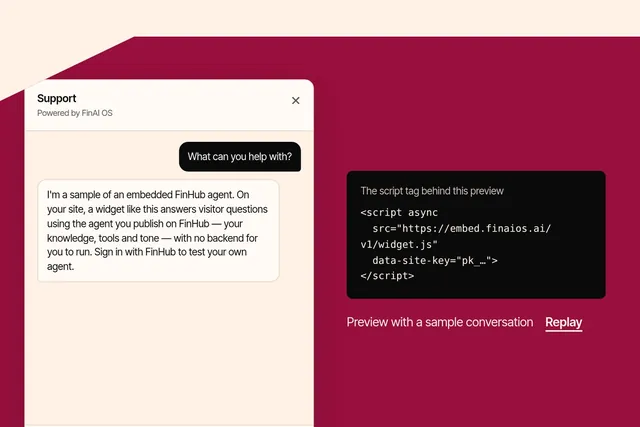
Put an agent you publish on FinHub onto any website with one script tag, in your brand and your visitors' language. Try the playground or sign up at embed.finaios.ai.
FinHub is the governance and work plane for your company's agents, including the Super Agent work layer. Policy, identity, audit and skills stay on the platform, so you are not locked to one harness.
Guides
Put enterprise AI governance into practice: control agent access, review skills, limit execution, approve risky actions and keep records your team can review.
Enterprise AI governance turns decisions about AI use into permissions, operating rules, records and named responsibilities. For an agent that uses tools, it needs to cover more than which model employees may open.
Who may use an agent? Which tools and skills may it use? Where can its code run? What changes need approval? Who can review what happened? Each question needs both a technical control and a team that owns it.
Choose one workflow before granting broad access. Identify the people using the agent, the information it needs, the systems it may change and the person accountable for its results.
For an illustrative support workflow, reading a case, drafting a reply and changing the case status are distinct permissions. Decide which steps the agent may perform, which need review and which remain out of scope. A well-written prompt is useful, but it cannot replace those controls.
FinHub gives the IT team a control center for agents: identity, tenant-aware access, model choices, templates, skills and tools. Administrators decide what people may use, and skills are checked before installation, with human review as part of the approval process.
FinHub runs on your servers or in your private cloud. It manages FinClaw and supports Hermes through an adapter; the platform is not tied to a single agent engine. Its platform-agent conversations are appended to a write-once record. That record does not imply that unrelated tools or every endpoint conversation are covered.
FinSafe contains tools and code under file and network policies. FinGuard checks proposed changes routed to business systems, prevents duplicate actions and holds high-risk requests for approval.
These controls serve different purposes. A sandbox can block access to a destination; an action gateway can decide whether a specific permitted business change should proceed. Connect and configure the paths you intend to govern rather than assuming every action is covered automatically.
Agree who reviews conversation and action records, how long they are retained, and who may access them. Test denied operations, repeat requests, failed dependencies and approval paths. Re-test when tools, policies or models change, and assign owners for incidents and access revocation.
Self-hosting the platform does not by itself make model inference local. Your team still chooses the model endpoints, data sent to them and network controls. Technical controls support your governance process; they do not confer a certification or guarantee compliance.
For the evidence-review and reporting workflow, see Enterprise AI Governance & Evidence. Start with the controls the workflow needs and expand only with clear ownership and tested boundaries.
Explore FinHub, or talk to a Forward Deployed Engineer about a first governed workflow.